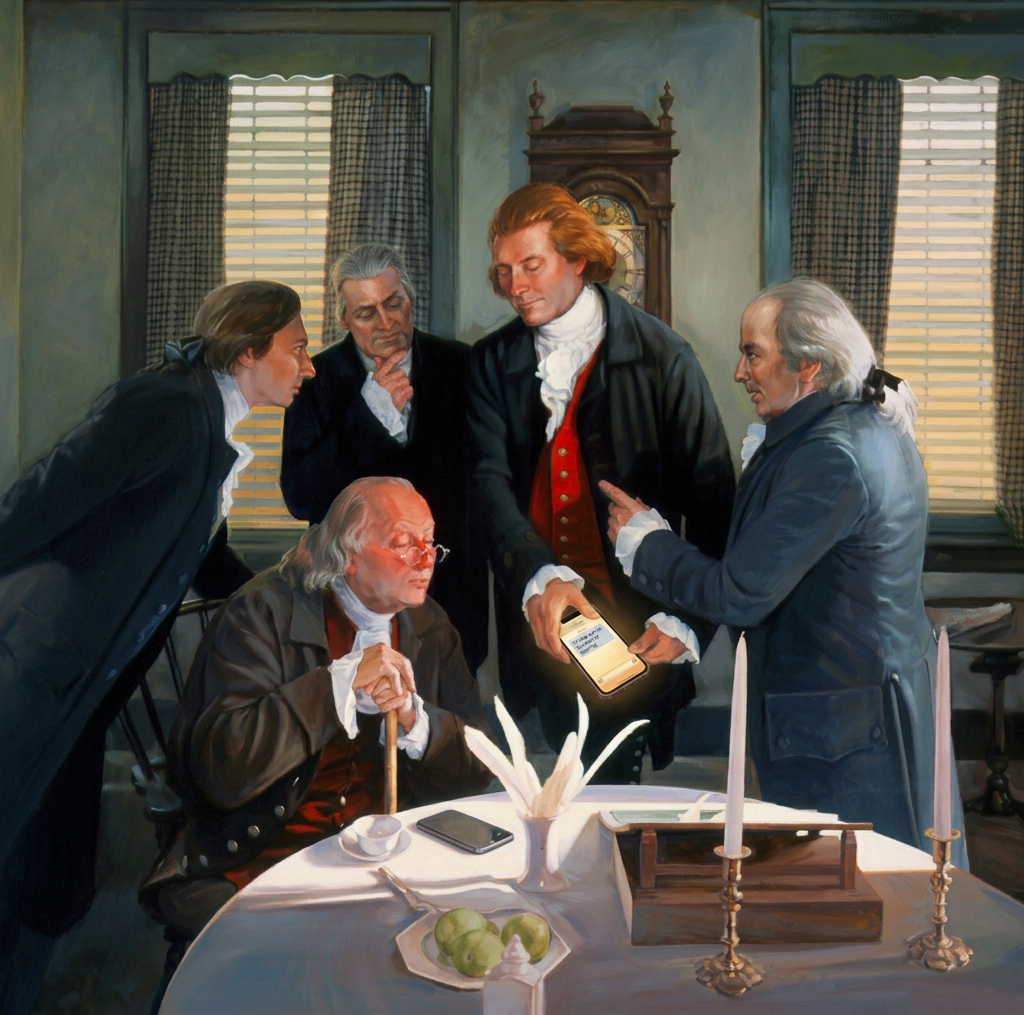
The Founding Fathers Were Not Ahead of Their Time. They Were Just Early to the Internet.
The Declaration of Independence is the most successful viral post in human history. It got a million reposts, launched a revolution, and has been quote-tweeted by every civil rights movement since. The original poster is unavailable for comment. The argument in the replies has never stopped.
America turns 250 this year, and the original thread is still up.
I've been thinking about this more than is probably healthy — the specific fascination of someone who has spent too much time online and cannot stop seeing the parallels. The Founding Fathers were not statesmen ahead of their time. They were content creators ahead of their time. They wrote in real names and burner accounts and open letters. They had beefs that lasted decades and spilled into the press. They built personal brands, started group chats that devolved into chaos, and produced a founding document of such strategic ambiguity that it has been generating engagement for two and a half centuries.
That ambiguity wasn't a flaw. It was the invitation. They wrote a thread they knew no single generation could finish, and they left the replies open on purpose.
The men were the accounts. The documents were the posts. And we are all — whether we like it or not — still living in the replies.
The Group Chat Nobody Could Leave
In the summer of 1787, fifty-five men gathered in Philadelphia in a building with no air conditioning, wearing wool, to argue about how to run a country. The Articles of Confederation had failed so completely that everyone agreed on the need for change — which was the last thing they agreed on for the next four months.
James Madison arrived having done more homework than everyone else combined. He had read every political philosopher in the Western canon, synthesized it into a working theory of government, written it down in advance, and then took meticulous notes on every argument during the convention itself. Madison was live-tweeting a meeting he had organized. The windows were nailed shut. It was July in Philadelphia. History has been blaming the heat ever since.
Alexander Hamilton: The Account You Cannot Mute
Hamilton would post seventeen times a day. Not seventeen thoughts — seventeen threads, beginning 'A few words on centralized banking and why my enemies are constitutionally illiterate, a thread (1/34)' and delivering, in fact, thirty-four posts, each one escalating in argumentation and personal grievance until by post twenty-nine you'd lost the plot entirely but felt vaguely that someone should check on him.
He wrote fifty-one of the eighty-five Federalist Papers in six months, under a pseudonym, while also practicing law and raising a family. The Federalist Papers are, viewed without sentiment, an eighty-five-part thread. Nobody finished reading them then, either.
He would be ratio'd constantly. He would not care. He would ratio back. Hamilton's entire career was a ratio that escalated into a duel — what happens when a beef migrates from quote-posts to DMs to a field in New Jersey at dawn. He was almost always right and almost always intolerable about it. We made him a musical instead of a monument because we knew, instinctively, he was better at a distance.
Thomas Jefferson: Gorgeous Prose, Catastrophic Drafts Folder
Jefferson drafted the most stirring prose in American political history and also owned more than six hundred enslaved people over the course of his lifetime. This contradiction is so vast and so structurally load-bearing to the American project that it has employed historians for two centuries. I'm not going to resolve it here. I'm going to describe his posting habits and let the implications do their work.
Online, he would write long, beautifully composed threads about liberty that trailed off, around post nine, into something vague and evasive. The contradiction between the argument and the biography would live in every reply. He would not respond. His mute list would be a document of historical significance in its own right.
The actual drafts folder is already devastating. Jefferson's original Declaration included a passage condemning the slave trade — his finest paragraph, he believed — cut by the Continental Congress at the insistence of South Carolina and Georgia. He wrote the braver version, the room objected, and he posted the safer draft instead. He kept the original. He brought it up for the rest of his life. Every writer who has ever softened a sentence under pressure knows exactly how that felt.
Benjamin Franklin: The Lifestyle Influencer We Deserved
Franklin tracked thirteen virtues — temperance, silence, order, resolution, frugality, industry, sincerity, justice, moderation, cleanliness, tranquility, chastity, humility — marking daily failures with a black dot, cycling through each weekly. This is not a historical curiosity. This is a Habit Tracker. Franklin invented the Habit Tracker. He would have a newsletter about it and a waiting list for the embossed journal.
His podcast, The Junto — which is what he actually called his club — ran weekly for forty years, while he simultaneously invented bifocals, the lightning rod, and the public library. He would sell supplements. They would, somehow, work. Franklin was the only Founding Father who seemed to be genuinely enjoying himself, which is suspicious and probably the secret: he understood that a personal brand is just a consistent point of view applied everywhere, and his was I find this all rather amusing, and I believe we could improve it.
George Washington: Correctly, Not Online
Washington would not be online. This is the most important thing to know about George Washington, and right now the most aspirational.
His Farewell Address warned against political factions — 'a fire not to be quenched,' he called partisan spirit — predicting exactly what would happen if Americans sorted themselves into permanent opposing camps. He was describing Twitter one hundred and ninety-one years before Twitter. He was correct. It happened anyway. He then gave up the presidency and went home, because he understood that the act of surrendering power was more important than anything he'd done while holding it. He would not have a podcast. He would be in the garden. We would all be better off.
John Adams: The Ratio in Human Form
Adams would have the most accurate takes and the fewest followers — a condition so familiar to anyone who spends time online that it barely needs elaborating. He was prickly, pedantic, frequently correct, and constitutionally incapable of making himself likable. He wrote careful warnings about the fragility of republics that read today like dispatches from a well-sourced Cassandra who has given up expecting anyone to listen but cannot stop writing.
He and Jefferson had a friendship, a bitter estrangement, and a late-life reconciliation conducted entirely through letters — two people working out, in real time, whether a relationship can survive political disagreement. They concluded it could, barely. They died the same day: July 4th, 1826, the fiftieth anniversary of the Declaration. Adams's last words were 'Thomas Jefferson survives.' Jefferson had died hours earlier. Adams got the last ratio without knowing it. This is very Adams.
Patrick Henry and Sam Adams: Post and Ghost
Patrick Henry gave the most famous speech of the revolution — 'Give me liberty, or give me death!' — then spent the rest of his career opposing the Constitution. He is the account that posts something incendiary at eleven PM and then objects to the consequences. Sam Adams organized the Boston Tea Party, the founding era's greatest PR stunt, and then largely vanished from national politics once independence was achieved — the most active person in the group chat until the thing you were organizing actually happens, at which point you go quiet and leave without explanation. He knew that revolution is more fun than governance. He chose the fire. He left the aftermath to other people. We are still sorting the aftermath.
The Documents Were the Posts
The Declaration of Independence is a masterclass in content strategy. The hook — 'When in the Course of human events' — establishes stakes without over-explaining. The thesis — 'all men are created equal' — is quotable, emotionally resonant, and vague enough to be claimed by almost anyone. The grievance list is a numbered thread. The closing asks signers to pledge their lives, fortunes, and sacred honor, which is the founding equivalent of: if you agree, please repost. Fifty-six people did.
Jefferson's original draft was longer and braver. The committee cut the best paragraph. The published version was the safer post. The drafts folder, as always, tells the real story.
Published today, the Declaration would dominate every metric. The opening paragraph is the most-screenshotted text in American history — it arguably already is. 'Life, Liberty, and the pursuit of Happiness' appears in more social media bios than any other phrase in English. It would also, within twenty-four hours, receive eleven quote-posts saying 'well, actually,' and a reply from a verified account calling the grievances 'a bit much.'
The one-star Yelp review version — the most accurate contemporary framing — reads as follows:
★☆☆☆☆ "Had high hopes. Colonial arrangement involved undisclosed grievances, taxation without representation, and soldiers quartered in our homes without consent. Long list of specifics available upon request. We've gone a different direction. Would not recommend monarchy. Three follow-up letters sent. No response."
The Crown's response was a form letter. It always is.
The Constitution as Terms of Service
Nobody read the Terms of Service. This was true in 1787 and it is true now, for the same reason: the document is long, the language is technical, and agreeing was the condition of participation. You cannot use the country without clicking Accept.
The Bill of Rights is the comments section demanding features. The original product launched. Users objected immediately. The development team shipped a patch within three years: freedom of speech, assembly, press, protection against unreasonable search and seizure — features users had identified as essential that the initial release had somehow omitted. Whether the patch was correctly implemented has been actively litigated for over two centuries and is, at this moment, very much live.
Twenty-seven amendments total. Some expanded the definition of who the Terms cover. One prohibited alcohol; a subsequent one reversed it — the only time in American history we have collectively acknowledged a mistake in the founding document, written the correction in, and moved on. We have not managed this with comparable speed in any other domain, which says something about our relationship with alcohol, or error, or possibly the same thing about both.
We Are All Still in the Replies
Here is what I think, two hundred and fifty years in:
The Founding Fathers were not gods. They were smart, flawed, contradictory men who argued constantly and produced — through genuine vision, strategic ambiguity, and considerable luck — a document so precisely constructed that it could survive being read forward. Picked up by later generations and used to mean more than its authors intended. To include people they excluded. To demand things they weren't prepared to give.
Every expansion of American freedom has used the same move: get into the original thread and quote it back at the country. The abolitionists quoted Jefferson. The suffragists quoted Jefferson and Madison. The civil rights movement quoted the Declaration at courthouses that had spent decades pretending those words didn't mean what they said. Every person who has ever stood up and said 'you wrote all, and I am going to hold you to all' has been working in the replies — using the original post against the original poster. This is either the greatest trick in political history or the most American thing imaginable. Probably both.
The thread is still live. People are still posting about it, arguing about it, citing it in federal court and in the streets. Teenagers are filming TikToks in front of the National Archives. Someone is, right now, getting 'all men are created equal' tattooed somewhere their mother will disapprove of. The post is still doing numbers two hundred and fifty years after it was uploaded, because it was written — accidentally or brilliantly, probably both — not as a description of what America was, but as a question about what it could become. A finished promise is just a statement. An open question is an invitation. They left the replies open on purpose.
The original posters are gone. Their accounts are inactive. Their intentions are disputed by everyone with an opinion and a search engine. The argument about what they meant, and who it covers, and whether we are living up to it, is the same argument it has always been — faster now, noisier, conducted across more platforms than they could have imagined — but the same argument. It has never resolved. It was never supposed to.
Two hundred and fifty years in, the thread is still open.
Get in the replies.