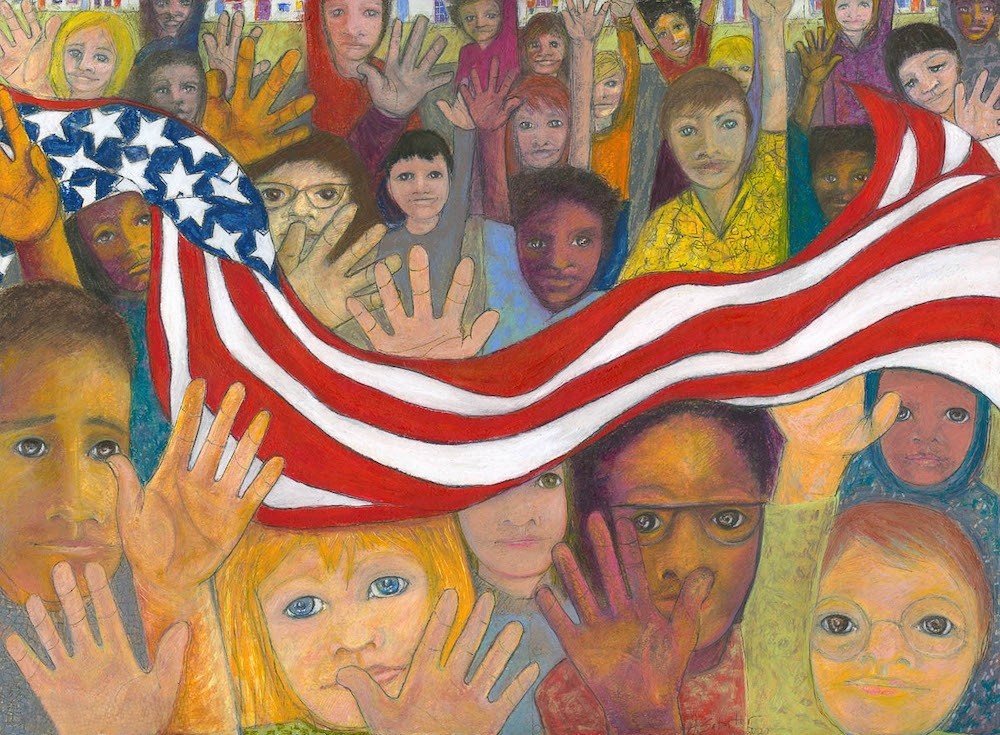
Every morning, in tens of thousands of American classrooms, children stand, place a hand over their heart, and recite twenty-two words composed in 1892 by a Baptist minister moonlighting for a magazine's flag-sales department. This is presented to them as a solemn civic inheritance. It is closer, in spirit, to a jingle that never got a follow-up campaign.
The minister was Francis Bellamy, and by most accounts a serious one — a Christian socialist with real opinions about the poor and the greedy, opinions that did not survive contact with his day job. That job was at The Youth's Companion, which sold flags to schools and needed schools to want them. Bellamy was handed the assignment the way a junior copywriter today might be handed a tagline brief, and he delivered: brisk, universal, unthreatening, exactly long enough to fit on a classroom wall. Whatever radicalism he had left over, he kept out of the copy. The flags moved. The pledge, unlike most successful ad campaigns, failed to go away.
It has since been revised twice, and both revisions are more instructive than the original.
The first concerned the gesture. Bellamy's pledge came with choreography: right arm raised, palm up, extended toward the flag — held there for the duration, like a particularly patriotic game of Simon Says. American schoolchildren performed this every day for fifty years, and it went entirely unremarked upon until roughly 1936, when it became difficult not to notice that several European governments had started doing something extremely similar, with considerably worse intentions. By 1942 the resemblance was no longer a coincidence anyone wanted to explain, and Congress replaced the raised arm with the hand over the heart — not because a committee convened to reckon with what the gesture meant, but because it had become, overnight, an unfortunate visual. This is the single least examined incident in American civic life: for one uncomfortable stretch of the twentieth century, the pledge of allegiance and the salute of fascism were doing the same thing with their arms, and the fix was cosmetic.
The second revision concerned God, who did not appear in the original pledge at all. Bellamy, minister though he was, wrote a secular oath — "one nation, indivisible" — and it stayed that way until 1954, when the Knights of Columbus successfully lobbied Congress to insert "under God" between "nation" and "indivisible," with the Eisenhower administration's blessing. The stated reasoning was spiritual. The actual occasion was the Soviet Union, which had the twin disadvantages, from an American PR standpoint, of being both godless and a nuclear power, and needed to be out-branded on at least one front. So the pledge was amended not by theologians but by Cold Warriors, the same way a soft drink gets a new slogan when a competitor enters the market. It has been there ever since, unremarked, treated by most Americans as though it arrived with the Pilgrims.
There is a tidy irony in all of this, and it is tempting to make too much of it. The temptation should probably be resisted, since the pledge's actual comedy is not that it is secretly cynical — it's that nobody involved was being cynical at all. Bellamy believed in the nation he was describing, even while writing ad copy for it. The Knights of Columbus believed in the God they were inserting, even while doing so as opposition research on the Soviets. Congress in 1942 believed in the flag, even while frantically distancing it from an armpit angle. Everyone meant it. That's the part that should unsettle you, not the marketing.
Which is presumably why no one has proposed truth-in-advertising amendments along these lines:
I pledge allegiance to a flag, originally sold door-to-door, and to the compromises for which it stands: one nation, arm lowered for optics, under a God inserted for the Cold War, with liberty and justice negotiable, terms subject to change.
It doesn't scan. Nobody's standing up for it. But somewhere Francis Bellamy, socialist, minister, and copywriter, is nodding — he, of all people, would recognize good ad copy when he heard it, and forgive it for being untrue.