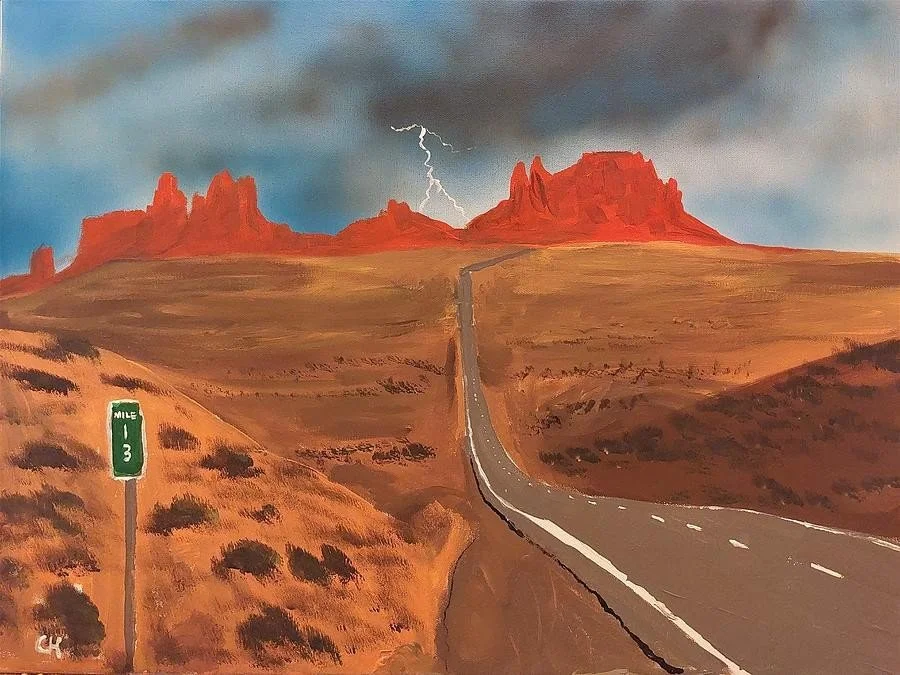
There are countries where roads connect places. America is not one of them.
In America, the road is not connective tissue — it is ideology laid flat and painted yellow in the center so no one forgets which direction is forward. We did not merely build highways; we built a metaphysical system with exit ramps. Its official name — the one nobody uses, because it ruins the mood — is the National System of Interstate and Defense Highways. Congress signed it into law in 1956, and if you read past the title, you will find that the open road, the one every American novel since has treated as a private confrontation with the soul, was budgeted primarily to move tanks.
Dwight Eisenhower did not dream up the interstate on some sunlit ridge, moved by the poetry of distance. He dreamed it up in 1919, watching an Army convoy take two months to cross a country a Roman legion could have managed almost as fast. He spent the rest of his career making sure that never happened to him again — forty-odd thousand miles of interstate, built to move armor in an emergency, and, as an unbilled side effect, to make it very easy to leave your hometown without saying why.
A year later, Jack Kerouac published On the Road. Congress had funded a defense system. American literature promptly adopted it as a spiritual condition.
We call the result freedom, and in a narrow technical sense it is: you may drive in any direction you like, provided the direction eventually resolves into another exit ramp selling the same three fast-food chains under a different sunset. The symbolism holds because symbolism is cheaper than infrastructure and needs no maintenance budget. The engine runs. The horizon recedes at a fixed and reassuring rate. Nobody asks too many questions about why you left, because answering would require admitting you might not have been driving toward anything — only away. Every mile marker is a small, government-funded alibi.
Americans almost never describe happiness as arrival. We describe it as forward motion. Promotions are upward. Relationships move forward, or they don’t, and then they’re a dead end. Careers stall. We get stuck, spin our wheels, change lanes, take a detour, find our path, get back on track, and, if all else fails, hope life offers another off-ramp. Somewhere along the way, we stopped speaking English and started speaking Department of Transportation.
This not-asking is the whole liturgy. Nobody says, out loud, from what, exactly — impolite, and beside the point, in a religion whose central sacrament is not stopping. Other countries build cathedrals and ask you to sit still in them long enough to be changed. We built on-ramps and agreed to let the passing-through itself count as the change. It fits in a cupholder.
It is also, in more literal cases than the metaphor prefers, a religion practiced by demolition. The interstates did not simply pass through American cities; in city after city, someone with a planning office and little supervision routed them straight through the Black and immigrant neighborhoods nobody downtown had zoned for anything more permanent than removal — Overtown in Miami, Rondo in St. Paul, Trémé in New Orleans, paved over on the theory that a community is easier to relocate than a highway is to reroute. The erasure was never only personal, never only the pleasant fiction of a man in a Ford discovering he’s someone new by mile forty. Sometimes it was zoning. The road that let one American reinvent himself was, for another, the thing that arrived and erased the neighborhood altogether.
None of which stops the interstate from delivering, with total sincerity, exactly what it advertises: motion, and the peculiar clarity that shows up once the landscape reduces to intervals — gas station, billboard, town that briefly impersonates permanence before admitting it was only ever a rest stop with ambitions. The country looks most like itself at seventy-five miles an hour, precisely when you have the least time to examine it. A nation with this much to account for has good reason to prefer scenery that won’t hold still long enough to be cross-examined.
And yet the case against the road has a hole in it, and intellectual honesty requires admitting where. Nebraska is real. So is the two hundred miles of Interstate 40 through the Texas Panhandle, a stretch of pavement that exists mainly to make a philosophical point about patience. There are landscapes in this country too large to be understood from a photograph and too fast to be understood from a plane, and the only instrument sensitive enough to register them is several bored hours of your own life, spent moving through them at a speed that qualifies as effort. Call it the one true fact hiding inside the propaganda: some truths in America are simply too big to fit into a sentence, and have to be driven through instead. This does not make Kerouac correct, exactly. It makes him lucky — a man who mistook a real national fact, that the country is enormous and enormity teaches something, for a personal revelation, that he, specifically, had found it. The road does not manufacture wisdom. It only clears enough silence for wisdom, if you happen to be carrying any, to catch up with you.
Thoreau and Steinbeck, waiting somewhere past their own last chapters, would not let each other off the hook on this one. Thoreau would recognize the argument immediately — duration produces truth, that was the entire premise of two years at a pond — and object only to the framing, not the physics: the interstate has not invented anything, it has simply moved his experiment to seventy-five miles an hour and taken away the beans.
Steinbeck would be harder to pin down. He wrote that the road was theft, in a novel about people who lost everything to it. Then he drove the country himself, with only a French poodle for company, and returned convinced he'd learned something the landscape would only say to a man in motion. He never quite managed to explain what it was.