An imagined conversation between John Muir and Walt Disney
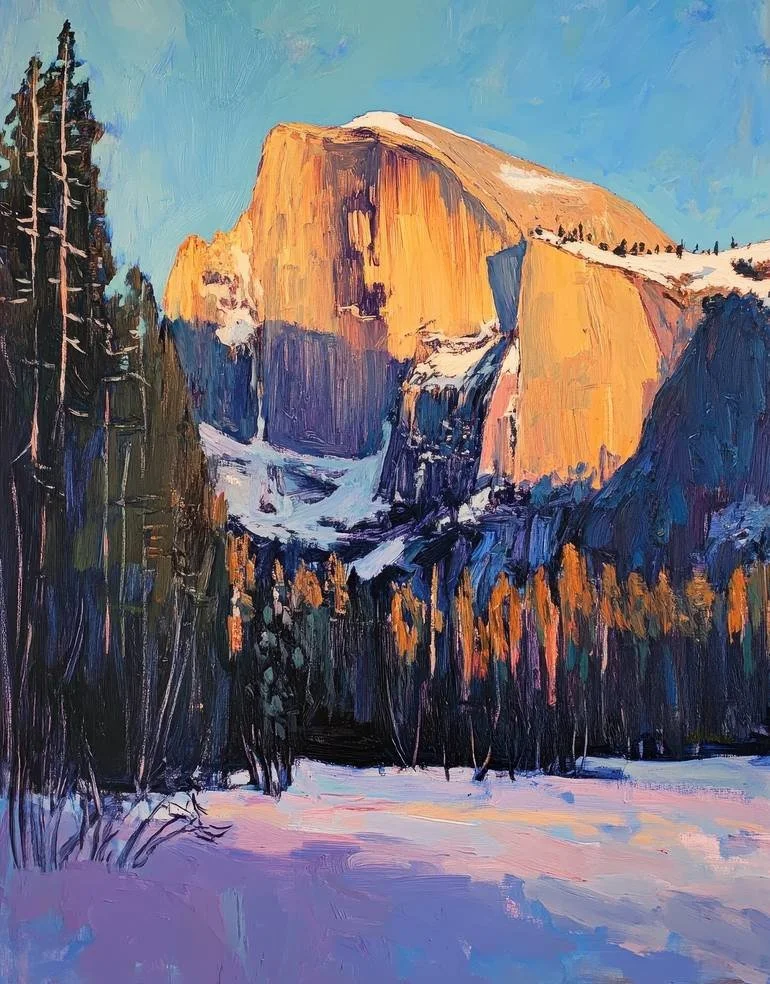
There is a waiting room, somewhere past the last chapter, reserved for Americans who felt something so completely that the country turned around and started selling tickets to it. Norman Rockwell is in there, permanently explaining that he only ever painted four covers about it. Currier & Ives gave up correcting the record decades ago. And in one corner, by a window that looks out on either a granite valley or a parking structure depending on which way the light falls, sit John Muir and Walt Disney, who have been waiting fifty-two years to have this argument.
Muir got there first, which he will not let anyone forget. He arrived in December of 1914, worn down by eight years of losing a fight for a valley called Hetch Hetchy, having caught the pneumonia that killed him while visiting a daughter in Los Angeles — a city he distrusted on principle and had the poor luck to die in anyway. Disney came later, in December of 1966, off a bad lung and a cigarette habit he'd kept out of the newsreels for forty years, still faintly smelling of the plaster from a scale model of a Florida swamp he had, until three weeks before the end, been redesigning by hand.
This is, more or less, where the conversation begins.
“You spent eight years fighting a dam with essays, and lost the valley anyway,” Disney says. “I spent one afternoon on a bench watching my daughters ride a carousel, and built an empire on the strength of it. Between us we've spent a century teaching Americans what a mountain is supposed to feel like — you did it with a notebook, I did it with a payroll.”
“Hetch Hetchy was not lost to a superior argument,” Muir says. “It was lost to San Francisco's thirst and Washington's indifference. I do not concede the comparison. I described a place. You built a substitute for one.”
“A substitute people can actually get to.”
“A substitute is still a substitute, sir, however level the parking lot.”
Here it should be said, in the interest of literary honesty, that these two men would have found each other nearly incomprehensible within about four minutes of actual acquaintance, and might have been right to. Muir believed a landscape's whole power lay in its total indifference to the person standing in it — the mountain does not know you are there, does not care, and the not-caring is precisely what undoes a man in the specific way Muir spent his life trying to describe. Disney believed indifference was simply an unsolved engineering problem. If a mountain could not be made to care whether you showed up, on schedule, refreshed and photographed, then a mountain could at least be replaced with something that would. Muir went into the Sierra to be humbled by something enormous and unbothered by him. Disney built an industry on the premise that no American family should have to travel further than Anaheim to feel humbled by anything.
“You want to know what I actually think of your valley,” Disney says. “I think it's the finest unbranded property in American history, and I mean that as a compliment. One careful owner, exceptional light, previous tenant achieved transcendence, some assembly required. It still sells better than anything my Imagineers ever built from scratch — I know, because I copied the room. The Ahwahnee. Granite pretending to be rustic, built by the Park Service thirteen years after you died, to sell your own valley to rich donors. I copied it twice, coast to coast, and called it Wilderness Lodge. It has a geyser with a wind sensor. You'd have hated it.”
“That is precisely the corruption I gave my life opposing,” Muir says.
“Your life, or your sawmill? Hutchings paid you to cut the valley's own trees into lumber for tourist cabins, by your own account, the same summer you were writing that the place had undone you religiously. You guided his paying guests up the very trails you were having your visions on. I've built exactly one thing you didn't already start, Mr. Muir. A gift shop at the end of it.”
Muir is quiet a moment.
“I have never denied the sawmill,” he says finally. “I have only ever denied that it changed what happened to me at the creek's edge. A man may be employed by commerce and still be ambushed by something commerce did not order.”
“Ambushed is a good word for it,” Disney says. “I built a whole company on ambushing people, on a schedule, for a fee. The only real difference between us is I put it on the marquee.”
“At least your ambush required no permission from a shareholder,” Muir says. “You wished to build an actual city once. Twenty thousand souls, I am told, and not one of them permitted to vote for who governed them, because you had arranged that none of them would own the ground they stood on. A mountain does not require your consent to move you. A landlord, historically, has required rather more.”
“EPCOT was never built,” Disney says. “You're arguing with a blueprint.”
“I am arguing with a man who wrote to his own government in 1941 asking it to investigate his own employees for the crime of asking to be paid fairly, and who named them personally when it obliged him. That was built. It cost men their careers for a decade.”
For the first time, Disney has nothing clever ready.
“Sorrell was a son of a bitch,” he says.
“Was he a communist?” Muir asks.
“No,” Disney says. “Probably not. I said it anyway, in front of Congress, with my name on it. I've had sixty years in this room to improve on that answer. I haven't managed it.”
It is the kind of exchange that could sour the whole room, and doesn't, entirely, because underneath the sparring both men are chasing a version of the same complaint: that most Americans had been quietly locked out of awe by geography, or money, or both, and that this seemed to both of them like an unacceptable arrangement. Muir spent thirty years lobbying Congress and presidents so that a valley once reserved for whoever could afford the stagecoach might belong, on paper, to a hotel clerk in Cleveland who would probably never see it. Disney looked at that same hotel clerk and decided the trip itself was the obstacle, and that the feeling could simply be shipped. Both men, in their own vocabulary, called this democratic. Both were, in their own way, correct, and both left something out of the sentence to get there.
A lesser version of this conversation ends with Disney comprehensively outclassed — the vulgarian confronted by the genuine article, sent back to his gift shop chastened. Both men deserve better than that, and so, it turns out, does the valley.
“May I ask you an ungenerous question,” Disney says.
“You've been asking them for the length of this piece,” Muir says.
“This one has a name. The Ahwahneechee.”
Muir does not answer immediately.
“You wrote that the valley was pristine,” Disney says. “Untouched. Found, in your word, not made. But people had been burning those meadows on purpose for longer than either of our countries have existed, to keep them exactly as open as you found them so photogenic. Some of them were still there when you arrived — what was left, after the militia finished with the rest, less than twenty years before your first summer. You wrote down what you thought of the ones who remained. I've read it. I built a fake jungle with animatronic monkeys and never once called it authentic. You called your view authentic and left the actual residents out of the description entirely. I'd like to know which one of us did the worse thing to that valley. I've genuinely never been sure, and I built a wind sensor for a geyser.”
Muir looks, for the first time in fifty-two years, like a man searching a text he has read a thousand times for a line he now suspects was never there.
“I did not see them as belonging to the land,” he says finally. “I saw the land as belonging to no one, which was, I understand now, its own way of arranging for them not to be seen at all. I called it a temple. A temple implies no one was living in it. I do not have a better answer than that, Mr. Disney. I have had sixty-odd years longer than you to produce one, and the account still will not balance.”
Neither man says anything further for a while. Outside the window, the light shifts — granite or parking lot, it's hard to tell from this angle — and somewhere, right on schedule, a company neither of them controls anymore is deciding which name goes on next year's calendar, and which one goes on the hotel.
A note on the form: this piece is a work of imaginative nonfiction. The dialogue is invented, in the tradition of imagined-encounter essays, to explore a real intellectual kinship and real tension between two men who never met. The biographical facts referenced — Muir's employment at James Hutchings's sawmill and hotel in Yosemite Valley, his published description of Yosemite's Indigenous residents, the 1851 militia campaign against the Ahwahneechee people, the Sierra Club's 2020 apology for views recorded in Muir's writing, the 1927 construction of the Ahwahnee Hotel under NPS director Stephen Mather, Disney's own account of Disneyland's origin on a Griffith Park bench, the unrealized EPCOT city plan, Disney's 1941 Variety advertisement and 1947 HUAC testimony naming Herbert Sorrell, and Disney's Wilderness Lodge and its wind-sensor-equipped geyser — are accurate. Muir died in December 1914; Disney died in December 1966.